Multi-Agent AI Needs Governance and Oversight, AIDC² Panel Warns
Category: NewsDate:
Share If You Like!
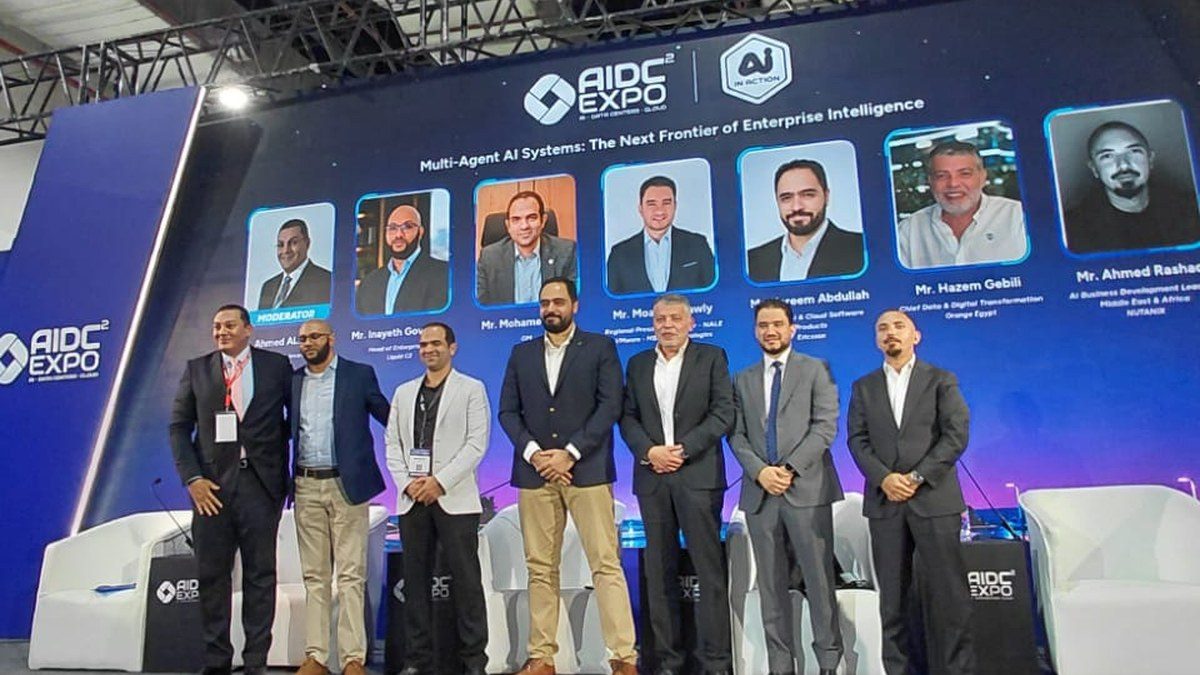
Experts from Liquid C2, Nutanix, FEDIS, VMware, Ericsson and Orange said on 8 November that multi-agent AI systems demand management, governance and security, not just new technology.
As companies move from single AI models to systems in which several AI agents work together, questions of control, security and accountability become sharper. That was the message of the panel "Multi-Agent AI Systems: The Next Frontier of Enterprise Intelligence", held on Sunday 8 November in Hall 3 as part of the AIDC² conference at Cairo ICT 2026.
The moderator, Mr. Ahmed Abdel Latif, International Telecom Expert, opened by noting that Egypt's personal data protection law, launched the week before, would apply to AI models as well as to people, and he made it one of the session's themes.
Mr. Inayeth Govender, Head of Enterprise AI at Liquid C2, said building a multi-agent system means weighing management, governance, security and technology together. The starting point is to help the people who deliver services adapt to AI, and then to train them. Using multi-agent AI is a collaborative process involving many parties, he said, and not simply a technology.
Mr. Ahmed Rashad, AI Business Development Leader, Middle East and Africa at Nutanix, said security risks rise with multi-agent models because they take more complex decisions and reach more complex results. Many factors therefore have to be weighed before an organisation decides to rely on them.
For Mr. Mohamed Afifi, GM of FEDIS, the greatest danger is an agent carrying out tasks it was never given, because of some fault, when oversight is weak. Frameworks to govern the use of multi-agent AI are now being defined, he said, with the protection of the data inside these systems as a central aim.
Mr. Moataz Shawly, Regional Presales Manager, NALE at VMware (MBcom Technologies), said AI is more than a business model. The real measure is the ability to run a model and to protect it, and only then can an organisation build on multiple agents.
Mr. Kareem Abdullah, Head of AI and Cloud Software Products at Ericsson, set out three steps for adopting multi-agent systems: first, coordinate between the departments responsible; second, divide the tasks assigned to the AI models; and third, evaluate each stage on its own, so that an error in one stage does not affect the others.
Mr. Hazem Gebili, who leads data and digital transformation at Orange Egypt, said AI is not only a technology but a complete business model. It depends, he said, on how an organisation handles management, risk, spending, security and the other factors that shape its decisions. The session was part of the third edition of the AIDC² Expo, the AI, data centre and cloud show held within Cairo ICT 2026.
Photo: ICT Business.