Egypt Has What It Takes to Grow Its Data Centre Industry, AIDC² Panel Says
Category: NewsDate:
Share If You Like!
Leaders from Nutanix, Telecom Egypt, Raya Data Center, Pulse by Solutions, El Sewedy Digital and HPE said Egypt's location, cables and skilled people position it to win global data centre investment.
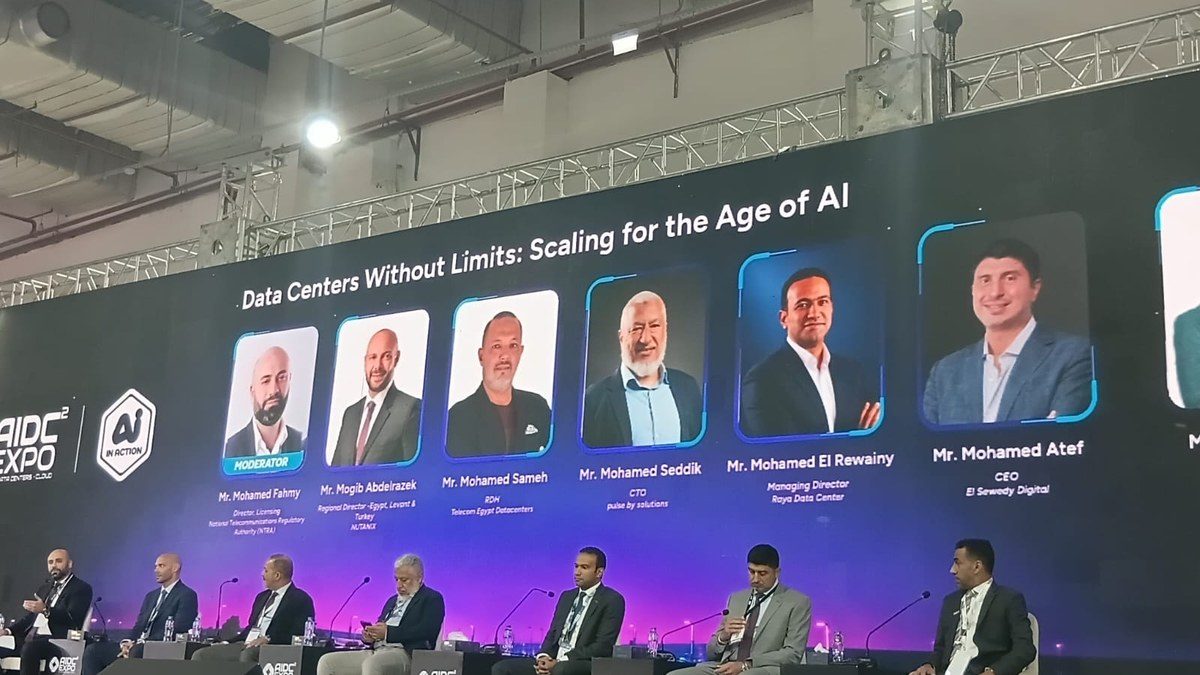
Egypt's location, infrastructure and engineers give it what it needs to expand its data centre industry and attract global companies, according to speakers on the panel "Data Centers Without Limits: Scaling for the Age of AI" at the AIDC² Expo on Sunday 8 November. The session, in Hall 3, was moderated by Mr. Mohamed Fahmy, Director, Licensing at the National Telecommunications Regulatory Authority (NTRA).
Mr. Mogib Abdelrazek, Regional Director, Egypt, Levant and Turkey at Nutanix, said the company expanded first in Saudi Arabia and the UAE before choosing Egypt about three years ago. It now employs around 400 people in the Middle East, has reached sales of $100 million in a single year, and last year launched what he described as the first fully local cloud in Egypt. Turning to Saudi Arabia, he said companies there had moved towards outside cloud services over the past five years, citing the closure of 280 data centres. Egypt, he said, can deliver cloud and data centre services to a high standard thanks to the experience of its workforce.
Mr. Mohamed Sameh, Chief Executive of RDH, Telecom Egypt's data centre company, said geography gives Egypt a competitive edge, helped by Telecom Egypt's network linking the Red Sea and around 15 submarine cables. The company built and runs the RDH1 and RDH2 data centres, opened in 2017 and 2018, and plans further investment in new sites. Global companies with large customer bases are looking for locations such as Egypt, he said, noting that a 100 MW data centre can cost up to $1 billion to build.
Mr. Mohamed El Rewainy, Managing Director of Raya Data Center, said investors need qualified infrastructure as well as incentives. Raya is focusing on AI applications as a source of economic and investment opportunity. He sees solid demand in Egypt and the ability to serve foreign markets, especially in IT services, and said the company is open to new investment, although global turbulence is affecting decisions across the data centre sector.
Mr. Mohamed Seddik, CTO of Pulse by Solutions, said the company is expanding in Africa with a focus on Egypt, alongside Saudi Arabia, Oman, Libya and Qatar. Not every data centre has to be built for AI, he noted, since sectors such as technology and petroleum have needs of their own. Pulse already exports data and digital services to the United States and aims to export complete solutions, not only products.
Mr. Mohamed Atef, CEO of El Sewedy Digital, said there is a move to identify land in Egypt and prepare it with the infrastructure that data centres require. The state offers investors a range of incentives, he said, with the main aim of making Egypt more competitive on the cost of building data centres and encouraging property developers to take part in the sector.
Mr. Nabil Badawy, Technology Director at HPE, listed energy, water and skilled people among Egypt's strengths. Egyptian engineers are already sought for work abroad, he said, and HPE relies on more than 200 qualified Egyptian staff to deliver data centre projects for organisations around the world. He added that Egypt is showing clear political and economic will to support investors.
Photo: ICT Business.