AI Cuts Energy Use in Egypt's Telecom Networks, Operators Tell AIDC²
Category: NewsDate:
Share If You Like!
Etisalat Egypt saved 7% of network energy in AI's first year and Huawei reported cuts of up to 25%, as operators and experts discussed how AI is changing network management and security.
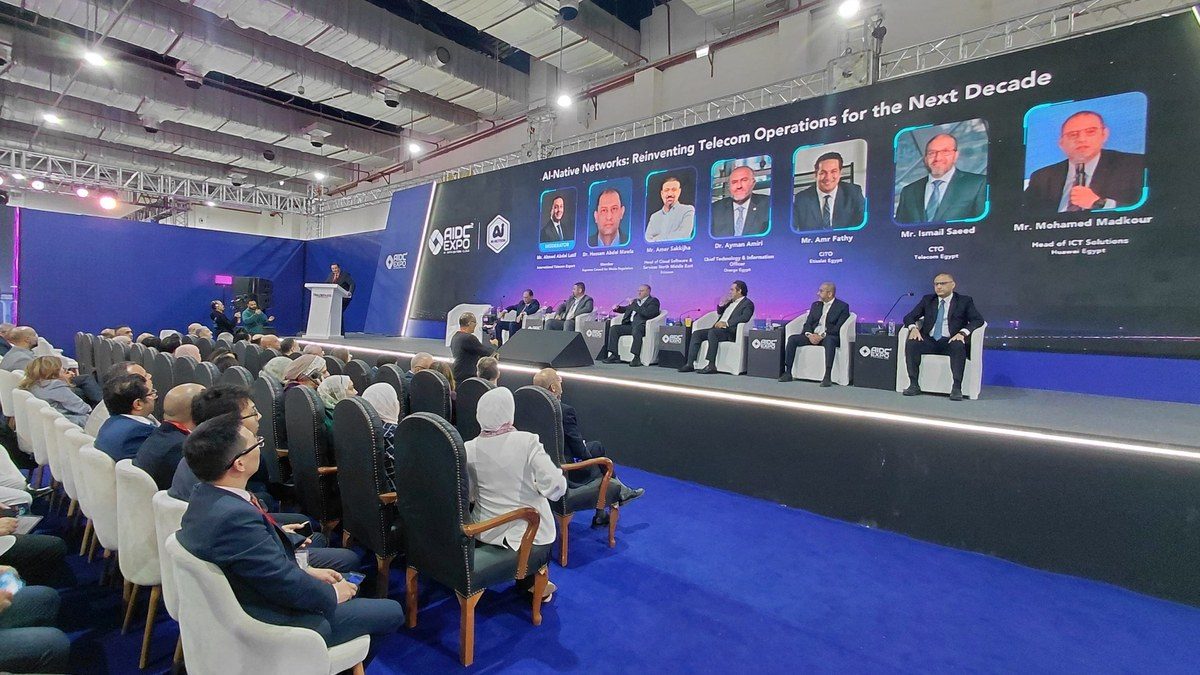
Artificial intelligence is already cutting energy bills in Egypt's telecom networks, operators told Cairo ICT 2026 on Tuesday 10 November. At the AIDC² session "AI-Native Networks: Reinventing Telecom Operations for the Next Decade" in Hall 3, moderated by Mr. Ahmed Abdel Latif, International Telecom Expert, speakers from Etisalat Egypt, Huawei Egypt, Orange Egypt, Telecom Egypt and Ericsson described what AI has delivered so far.
Mr. Amr Fathy, CITO of Etisalat Egypt, said an AI use case saved about 7% of the network's energy in its first year, a large saving given that the energy bill exceeds EGP 1 billion. The network has more than 100,000 cells across different frequency bands, which makes matching resources to demand complex. The same technology raised the share of customer service calls checked for quality from 1% to 90%, with near real-time results that can reveal network problems before operations teams spot them. He stressed that the energy project aimed at operating savings, not job cuts, and that bringing network and IT teams together made it possible.
Mr. Mohamed Madkour, Head of ICT Solutions at Huawei Egypt, said AI applications in Egyptian networks have cut energy use by up to 25% in some areas. Energy was a good place to start, he explained, because the goal is clear and results can be measured against past performance. Huawei, which has worked with all of Egypt's operators over 26 years, is working towards "Zero Bit, Zero Watt": using as little power as possible when no traffic is flowing, without hurting service quality.
Dr. Ayman Amiri, Chief Technology & Information Officer at Orange Egypt, said AI helps the operator understand and respond to customers, for example during power cuts, but warned that removing people entirely could lead to disaster: the final decision stays human. Orange now sees AI as a source of new revenue as well as savings, with network security a priority at every stage. Mr. Ismail Saeed, CTO of Telecom Egypt, said manual network management is no longer workable, and that intelligent systems let the company run its network across all governorates without human error. Mr. Amer Sakkijha of Ericsson said AI networks help operators cut spending and grow revenue while raising service quality.
Networks were also on the agenda on the opening day, 7 November, at the session "Powering Egypt's Digital Future: IPv6-Enabled Resilient Networks for the AI Era". Mr. Li Haifeng, responsible for IP solutions marketing for operators at Huawei, said more than 57% of data traffic is now encrypted, making it harder to analyse, and that preparing a one-terabit-per-second DDoS attack once took about 24 days but can now take 25 minutes. He cited an Optus outage in Australia lasting more than ten hours after a software update to a gateway in the United States.
Speakers recommended dual-plane network architecture, a mix of suppliers from East and West, protection against fibre cuts, and three layers of security covering devices, links and traffic. Mr. Mohamed Hamdy of Telecom Egypt said the company uses a multi-vendor strategy across its network layers and AI-driven digital twins to test scenarios before applying them. Mr. Hossam Sharkas of Etisalat Egypt pointed to scarce spectrum, the need for much larger IP and transport capacity, and network resilience.
Photo: ICT Business.