Designing AI Factories: Experts Map the Infrastructure Race at AIDC²
Category: NewsDate:
Share If You Like!
At an AIDC² panel on 8 November, Dell, HPE, Fortinet, Everpure, Silicon21 and Cisco said the AI race now turns on compute, ready data and secure infrastructure, not on algorithms alone.
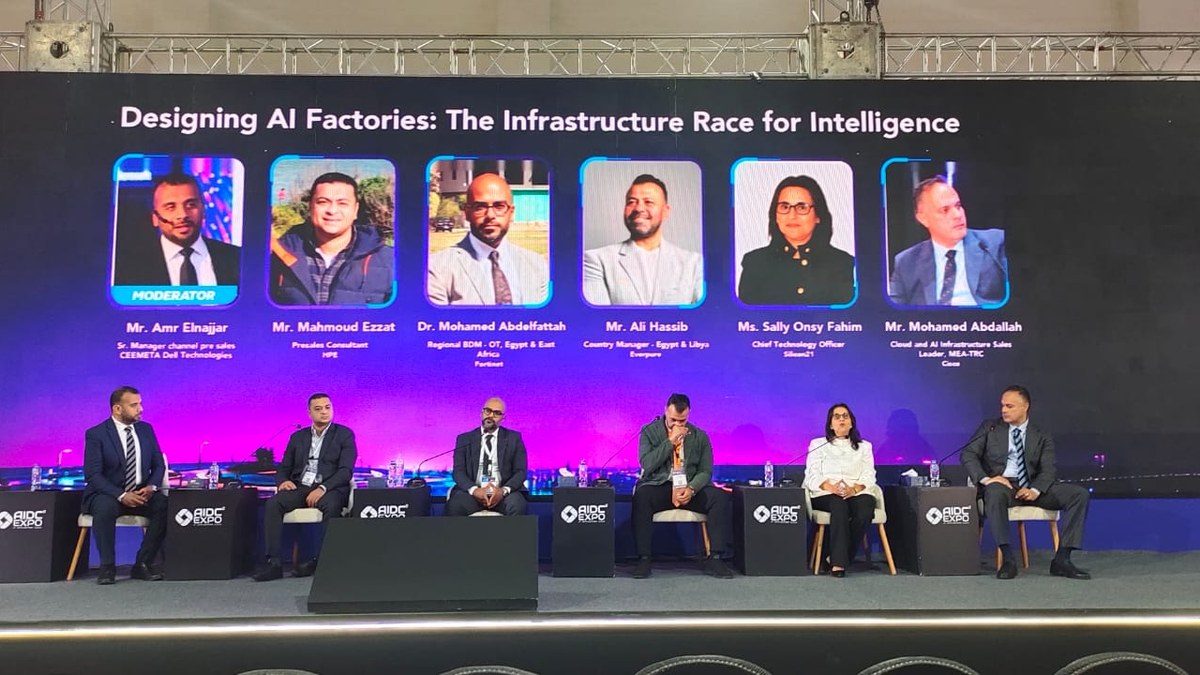
The global contest in artificial intelligence is no longer only about who builds the best models. On Sunday 8 November, the panel "Designing AI Factories: The Infrastructure Race for Intelligence", held in Hall 3 at the AIDC² Expo within Cairo ICT 2026, looked at what it takes to build the computing, storage, networks and security that move AI from pilot projects to large-scale commercial services.
Moderating, Mr. Amr Elnajjar, Director of Solutions Architecture, CEEMETA, at Dell Technologies, said many AI startups stall between proof of concept and production. The cause, he argued, is rarely the algorithm or the model. It is conventional infrastructure built as isolated silos. An "AI factory" brings compute, storage, networking and data pipelines together in one integrated system, and Dell's focus is on helping businesses design infrastructure flexible enough for AI applications to succeed and last.
Mr. Mahmoud Ezzat, Presales Consultant at HPE, explained that AI data centres are designed in a fundamentally different way from traditional or cloud facilities. They rest on a fabric architecture with three parts: a GPU fabric, a compute fabric and a storage fabric. The GPU fabric uses a Clos design, so organisations can scale out from a handful of GPUs to thousands, while a central orchestrator manages networks, compute and storage so that the whole site works as a single supercomputer.
Security of critical infrastructure was the theme for Dr. Mohamed Abdelfattah, Regional BDM, OT, Egypt and East Africa at Fortinet. For emerging economies such as Egypt, protecting utilities, transport and manufacturing is now a top priority, he said. Operational technology differs from IT: where IT protects data, OT controls the physical environment of plants and facilities. He pointed to standards such as IEC 62443 for industrial automation and NIST 800-82 for OT security, and warned that attackers increasingly favour indirect attacks on sensors, production-line controllers and smart devices rather than well-guarded servers. People remain the decisive factor, he added, and defence needs AI-based tools that anticipate threats.
Mr. Ali Hassib, Country Manager, Egypt and Libya at Everpure, said organisations that fail to make the shift to AI risk disappearing from the market. The common mistake is to focus on hardware while overlooking whether the organisation's data is ready. The first step is data discovery, finding where data sits across different systems, followed by unifying and cleaning it. Large language models are already available, he noted; the real value lies in feeding them an organisation's own data.
Ms. Sally Onsy Fahim, Chief Technology Officer of Silicon21, said the challenge is to turn traditional distributors into partners that add real value rather than simply selling hardware. AI projects need clear feasibility studies, she said, and skills remain one of the Egyptian market's biggest gaps, which calls for closer work with academies and educational institutions.
Mr. Mohamed Abdallah, Cloud and AI Infrastructure Sales Leader, MEA-TRC at Cisco, said the AI factory now reaches beyond the data centre to the cloud and the edge, and needs an integrated network and security fabric with strong observability. He put expected global investment in AI infrastructure at around $1.7 trillion in the coming period.
Photo: ICT Business.